
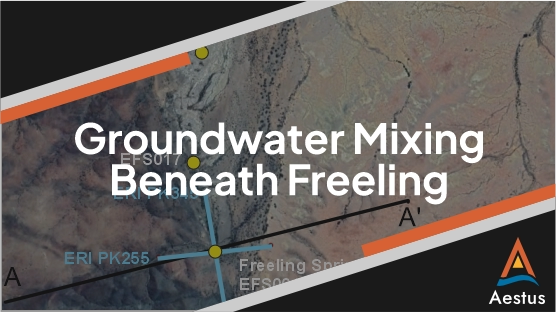
A 2020 study by Halihan et al. investigated the Freeling Spring Group in South Australia, where groundwater emerges at the boundary between two very different geological systems: the Great Artesian Basin (GAB) and a fractured granite mountain block aquifer.
The question was simple: Where does the spring water actually come from?
Traditional hydrogeology suggested the springs were primarily sourced from the Great Artesian Basin. To test this assumption, the researchers combined Electrical Resistivity Imaging (ERI) with detailed groundwater chemistry and mixing models.
The results revealed a much more complex system.
ERI identified three distinct subsurface flow paths converging beneath the main spring. Two pathways appeared to originate from different formations within the Great Artesian Basin, while a third pathway originated from the fractured granite mountain block west of the Kingston Fault.
Geochemical analyses confirmed the interpretation. Water chemistry showed that the spring discharge was not purely GAB water, but a mixture of sources. Mixing models indicated that approximately 90–93% of the spring flow originated from the Great Artesian Basin, while 7–10% came from the mountain block aquifer. At first glance, a 10% contribution may seem insignificant. However, that small percentage can strongly influence water quality, ecosystem function, and long-term spring sustainability. The findings also help explain why these springs have remained important water sources for both ecosystems and human use in one of Australia’s most arid regions.